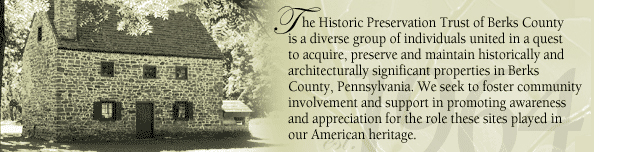
For more than 60 years, The Historic Preservation Trust of Berks County has pursued its mission of preserving some of the most significant historic buildings in Berks County, Pennsylvania.
Since its Charter in 1964, the Trust has acquired numerous architecturally and historically significant sites and structures in eastern Berks County, currently having custody of and preservation responsibility for eight stone buildings from the early settlement years of the region, including the oldest documented building still standing in Berks County, the Mouns Jones House:
Morlatton Village – Represents major elements of an early Swedish settlement first occupied in the early 1700’s, soon including mostly non-Swedes, and is considered the birthplace of Berks County. Additional structures constructed later in the 18th century complete the village. This site includes The Michael Fulp House, the Mouns Jones house, the Douglass Mansion, and the White Horse Inn.
Michael Fulp House (circa 1784) – Located just downriver from the Mouns Jones House, the Fulp House served as the residence of the son of a German immigrant through the Port of Philadelphia. Michael was a Revolutionary War veteran who became the Village handy-man and a journeyman carpenter. The Trust began restoring the roofless ruins in the late 1960s and implemented a structural restora-ion campaign in 2011-12, all detailed and illustrated in the Trust’s archives at Past Perfect Online.
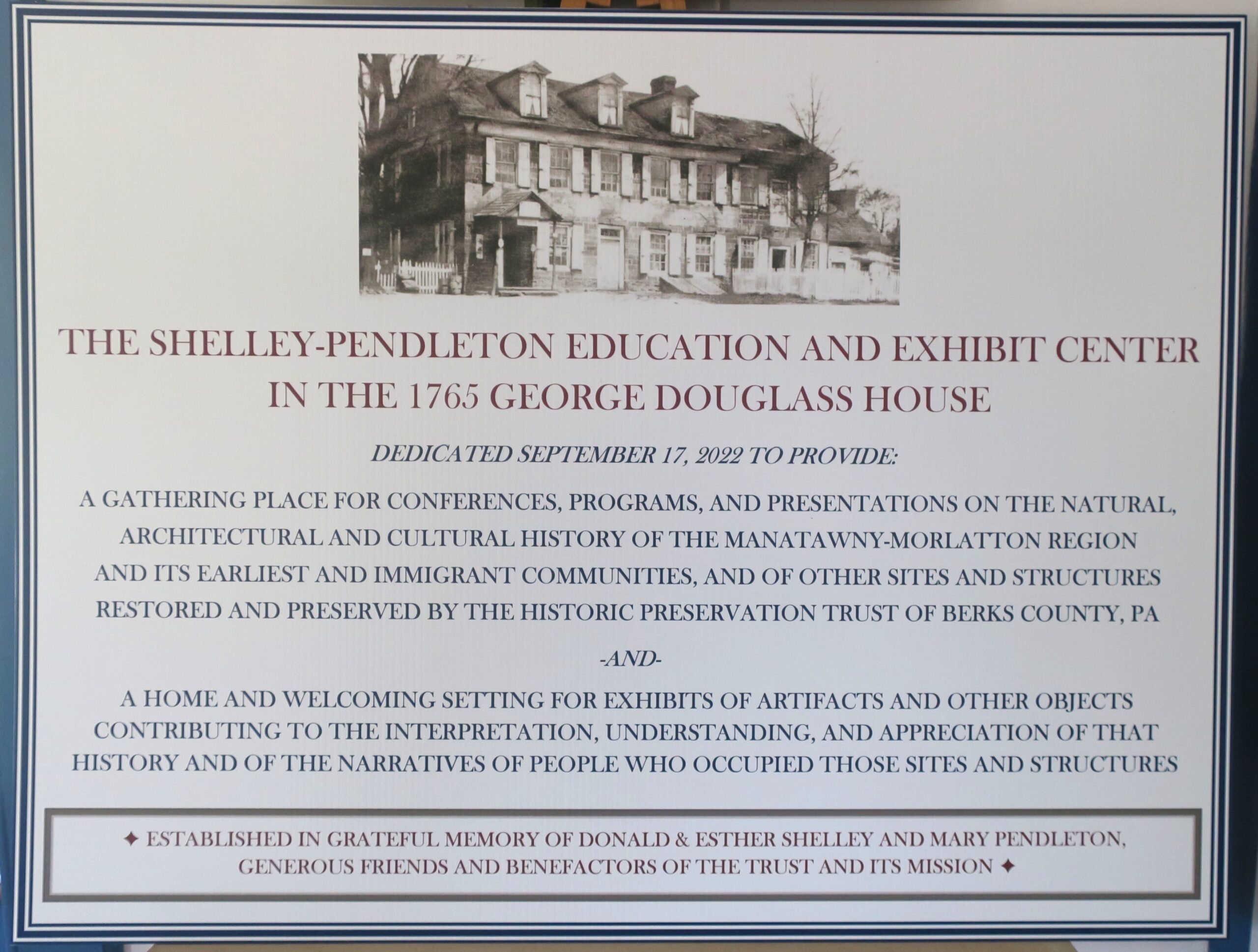 George Douglass Mansion (circa 1765) – Originally built and inhabited by colonial entrepreneur George Douglass, the mansion remains an impressive example of Georgian architecture. The Trust acquired the building in 1988 and began restoration, which is ongoing to this day. The house was dedicated in 2022 as the “Shelley-Pendelton Education and Exhibit Center” for instructive gatherings and display of architectural and archaeological artifacts from Trust sites.
Mouns Jones House (circa 1716) – Built by early Swedish settler Mouns Jones and his family, the house is the oldest documented dwelling in Berks County. However, it was not the first home for Mouns and his family. According to a report from an itinerant Lutheran Minister named Sandel, “Mans Jonasson” had “taken up residence” in Morlatton by 1704, presumably in a log structure, the foundation and hearth of which has been unearthed on the river side of the surviving stone structure by volunteers from Chapter 21 of The Pennsylvania Society for Archaeology.
The 1716 house is a two-and-a-half story sandstone structure with two chimneys, one venting the “walk-in” kitchen fireplace, the other a radial corner chimney, derived from both Swedish and English architectural traditions, which vents the parlor fireplace. The home has endured several inundating floods and fire damage to the roof, and by 1961 was roofless and had suffered the collapse of all three flooring systems. Except for the top few courses, most of wall and chimney masonry remained standing and structurally stable. The Historic Preservation Trust of Berks County embarked on a multi-decade restoration project beginning in 1965, continuing with periodic segmental campaigns to the present; the completed projects are detailed and illustrated in the Trust’s archives at Past Perfect Online.
White Horse Inn (circa 1762) – The White Horse Inn is of Georgian Style and its principal façade constructed of dressed sandstone similar to the Douglass masonry. Built circa 1762, and later enlarged by George Douglass by the 30bays to the left in the photo, the building served as a tavern during Colonial times and through the Federal period into the 19th century. It was preceded from the late 1720s until the1760s by Marcus Huling’s “Public House” in his home on the river, just south of Mouns Jones House, now within the Amity Township sewer plant site. Hulings’ house became the “White Horse” by the mid-1750s. The surviving White Horse was purchased by the Trust I n 1970 and has undergone significant restoration since. Today, the building is fully restored, adding a 20th-century frame kitchen. The Historic Preservation Trust of Berks County houses its office on the second floor. The Inn is available for private gatherings and events.
Hottenstein House – Located just outside Kutztown, PA, the main house was built in 1783 by David and Catherine Hottenstein. The house is an outstanding example of Germanic detailing applied to a standard Georgian floor plan. The house remained in the Hottenstein Family until 1976 when it was donated to the Trust. It is also listed on the National Register of Historic Places.
Johan DeTurk Ancillary Dwelling –The DeTurk dwelling and farmstead “ancillary” building on the southern ba,k of the Little Manatawny Creek has been recognized by the U.S. Government as “an important architectural survivor from the Colonial Period” and is documented in the Library of Congress. The Trust acquired custody of the building and its land parcel in 1967 under a 100-year lease. For over two centuries, the multi-function embanked structure housed a retirement dwelling for the elderly DeTurks, an attic granary, a farmstead cellar-kitchen and a barrel-vaulted “root-cellar.
Jacob Keim Farmstead – Located in Pike Township, the two 1750s stone structures on this site are excellent examples of 18th century German-influenced architecture. In 1978, the Historic Preservation Trust of Berks County acquired the farmstead by gift from Mr. and Mrs. M. Richard Boyer. The Keim Farmstead is listed on the National Register of Historic Places and in 2016 was awarded the rare status of a National Historic Landmark.
HPTBC Booklet
Click here for the HPTBC booklet “60 Years of Preservation and Education”. A complimentary copy will be mailed, while supplies last, to a USPS address emailed to info@historicpreservationtrust.org