Click here to search our online archive for documents and images associated with this building.
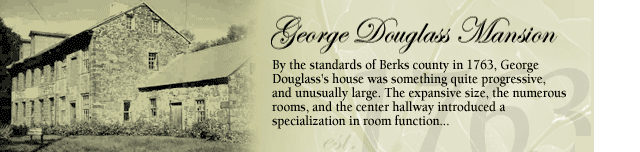
When constructed in 1765, according to a now illegible mortar date-plaque in a recessed stone frame in the northern gable-wall, the Douglass “Manor House” was an imposing example of a vernacular Anglo-Pennsylvania Georgian mansion,
Architectural History
After purchasing, or possibly overseeing the construction of, the original three bays of the extant White Horse Tavern/Inn, George Douglass built a red-sandstone Georgian mansion, completed by 1765, several hundred feet north of the new Tavern. The two and a half story structure provided ample living space for his family and for conducting his judicial and mercantile responsibilities. The mansion is a central passage, symmetrical Georgian structure with five principal façade bays.
During a roof restoration in the 1980s, the Federal-era dormers were removed and are currently on exhibit in the 2d-floor galleries or stored in the attic space. The exterior consists of fine cut “ashlar” stone, a plaster cove cornice, and a restored pent roof based on masonry evidence of the ceiled original. There is a deteriorated mortar date tablet which displayed a radial arrangement of George and Mary Douglass’s initials and a 1765 incised date [photo]..
The interior of the structure has been substantially restored, including kitchen and parlor flooring, re-plastering fireplaces, re-creating hearths with old bricks, and replacing missing elements of wooden paneling, and other molded details. The hierarchy of spaces is exemplified by the robustly articulated cornice moldings in the front [“best”] parlor and the “best” chamber above, compared to the more restrained cornices in the back parlor and chamber. The “best” rooms were where George Douglass conducted his business and judicial affairs, and where he housed important trading partners and other commercial travelers. The fine corner cupboard in the southeast room is probably a Federal period addition, installed when the store addition built near the turn of the 19th century. The second floor and attic retain much of their original woodwork and hardware.
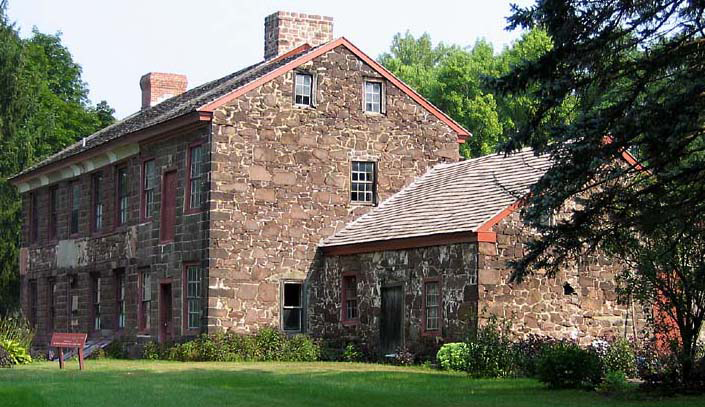 The 1799 Amity Tax List describes the property as having one stone house and one stone barn. Sometime after the Georgian period, the house was enlarged to accommodate Douglass’ general store operation, which was growing rapidly. The three-bay section to the east was added and operated as the “Amity Store” during the later 18th century and early 19th century by the Douglasses and their descendants.
The one story section to the east of the original section of the house was used as a kitchen or other domestic work building, including butchering and processing meat for sale. There is a small vaulted storage cellar with a chamber above for smoking meat. There are remains of an early stone privy to the rear of the house.
Property Chronology: George Douglass and his heirs owned the site and its buildings until at least 1944. Tax and Deed records narrate the ownership and uses of the Douglass sites, enterprises and buildings. The 1765 tax list records 70 acres of cultivated land, 50 acres of uncultivated land, 45 Pounds of rental income, 2 horses, 2 cattle, and he paid 4 Pounds 4 shillings of quit rent to the Proprietor. In 1767, George Douglass was listed as a shopkeeper, owned 175 acres, 1 horse, and was taxed 30 Pounds. The 1778 tax list shows Douglass with 120 acres of land (70 of which were cleared), 1 mare, 1 cattle, resulting in 3 Pounds in taxes. In 1781: 120 acres (106 of which were in Union Township), 1 mare, and 2 cows. 1785: Douglass described as a shopkeeper with 120 acres of land, 1 mare, and 6 cows. In 1786, he is listed as a shopkeeper with 120 acres of land, 1 mare, and 2 cows. The 1789 list has him as a storekeeper with 120 acres and 2 cows. The 1791 list has him as a storekeeper with 120 acres (100 of which were in Union Township), 1 horse, 1 mare, and 2 cows. In 1792, Douglass is listed as a storekeeper with 120 acres, 2 horses, and 2 cows. The 1794 list shows him as a storekeeper with 120 acres, 3 horses, and 2 cows. In 1795, the tax list describes Douglass as a shopkeeper with 90 acres, 2 horses, and 2 cows. The 1799 list shows him as a shopkeeper with 100 acres, 2 horses, 1 mare, and 2 cattle.
A Mr. Miller lived in the building during the early 1900’s, paying rent to the Douglass heirs. In 1969, the home was occupied by Edgar Webster. The Historic Preservation Trust of Berks County purchased the property in 1988 from Edgar’s daughter Betty and began a ten-year restoration campaigns, followed by several projects continuing through 2025..
Interested in learning more about the George Douglass Mansion and the Historic Preservation Trust of Berks County’s restoration campaigns on the house and its additions and dependencies? Search records, pictures, images, architectural drawings and more in our Online Archive.