Click here to search our online archive for documents and images associated with this building.
Morlatton Tavern History
The first innkeeper to obtain a license for a public house in the Manatawny backcountry was Marcus Huling (1687-1757), a Swedish Indian trader married to Mouns Jones’s daughter Margaret. Marcus is buried in the St. Gabriel’s church yard, remembered as an Indian interpreter and trader, successful innkeeper and entrepreneur, and a vestryman at St. Gabriel’s Church. He was also a local constable involved in the “Fishing wars”, a conflict between people using the river as a boating corridor and fishermen whose weirs impeded and sometimes capsized cargo boats. He also signed the 1744 petition creating Amity Township and joined earlier actions in support of extending and improving roads in the region connecting Manatawny to Oley, Reading, the Perkiomen Valley, northern Chester County across the river, and Philadelphia..
Eighteenth-century documents support the following chronology for the inception and transition of the White Horse tavern housed sequentially in two buildings:
In 1717 Marcus Huling purchased 200 acres of land fronting on the Schuylkill River a few hundred yards downstream from Mouns Jones’s house. By 1719 Huling had built a house close to the river, within the present-day Amity Township Sewage Treatment Plant tract. Both houses are shown on a 1719 road survey drawing, which clearly delineates the connections between the “Oaley Road”, “The Main Road to Philadelphia”, and the proposed ancillary road from the latter to the ford crossing to Milard’s grain mill.
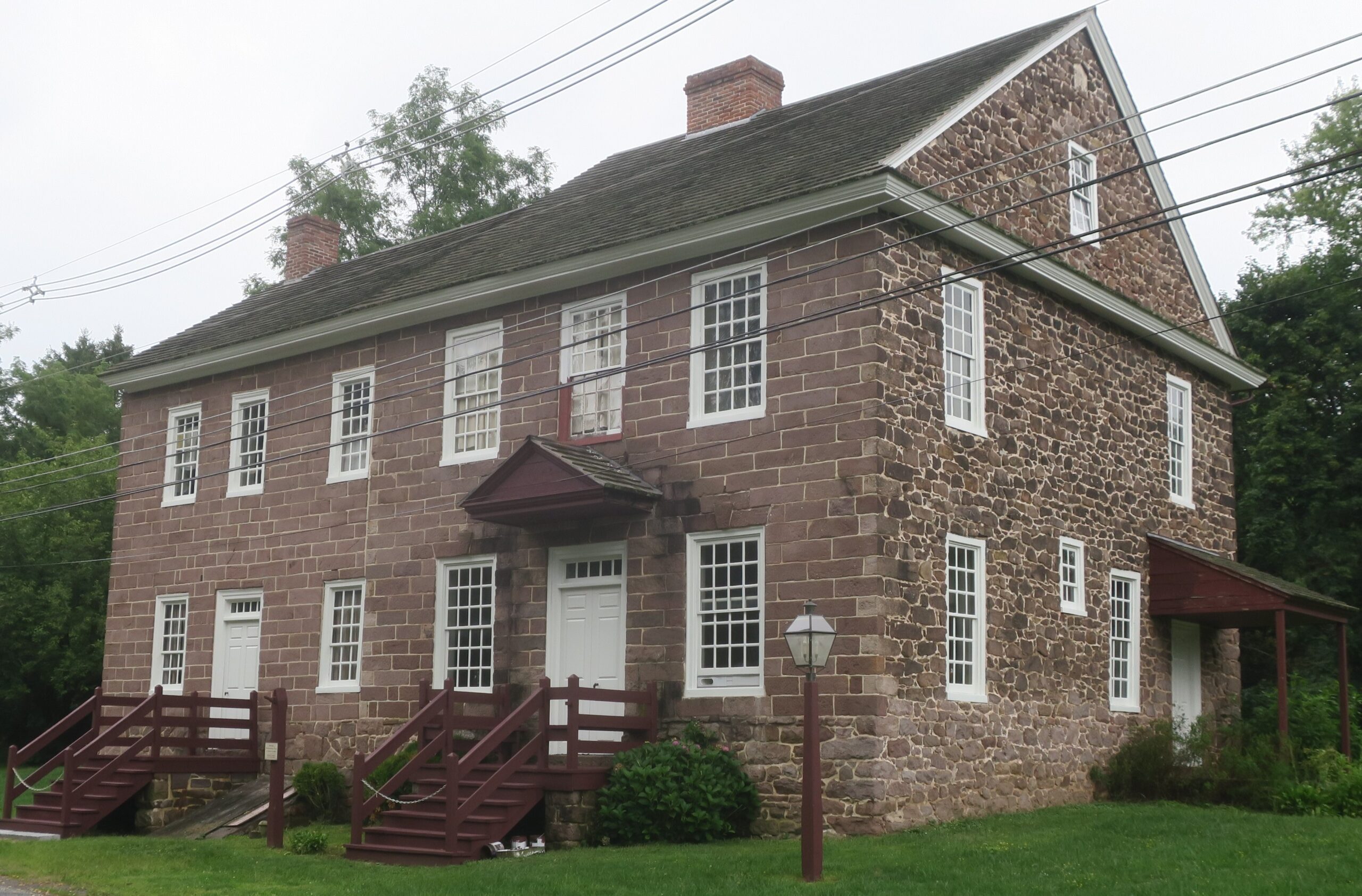
By the late 1720s, Huling had obtained a Public House license, authorizing the sale of wine and spirits in one or more rooms in his family’s home. In his “Observations” on a Journey in July, 1743 John Bartram noted that after leaving his “house on Skuylkil River“ he and Lewis Evans “stopp’d at Marcus Hulin’s by Manatony” before crossing the river and heading for Tulpehocken”. Huling conducted his tavern business in his house until 1750, when he sold the property (and presumably the rights to the “Pub” license), to Philip Balthsar Craessman [aka, “Cressman”], who re-licensed the tavern for 1751. In 1752, Craessman offered the land and inn, “where Marcus Huling formerly resided”, for sale, indicating that the Tavern had expanded to occupy most, or all, of the Huling house. A 1754 ad placed by an indentured servant “now with (the leasehold proprietor) of the White Horse in Manatawny” (proving that the first “White Horse” Tavern, as named by Craessman, was the “former” Huling house on the river by 1754) sought news of a fellow immigrant servant. Samuel Cookson purchased the land and tavern by 1757. An August 1758 list of tavern-keepers included Cookson in Amity. By 1765 George Douglass I had acquired or constructed the surviving 3-bay White Horse on its residual tract of land. He soon began leasing the new stone tavern on the “Main Road” (also called the “great road”) to a succession of proprietors, including Philip Cole from 1765 to at least 1773, Henry Haffa and John English during the Revolutionary years, and numerous others until 1820, when George Douglass II re-acquired the property via Sheriff’s sale. The Federal-era 3-bay addition was constructed of similar “ashlar” block-work, but with flat lintels over the windows, rather than the more classical “keystone-arch” form of the pre-Revolution structure.
A 1740 issue of the Pennsylvania Gazette listed an advertisement seeking to recruit troops for a British expedition against the Spanish West Indies during the War of Jenkins’ Ear, advising all potential army enlistees for an expedition to the West Indies that “Mr. Huling’s in Manatawny” was serving as one of twenty recruiting stations in the province. During the Revolutionary War, the tavern was a mustering place for the Continental levies and a training ground for militia. It was common for inns to be recruiting stations in the 18th Century but also, polling sites, Sheriff-sale venues, locations for meetings of the Society for the Prevention of Horse Thievery and other public gatherings, and sites for posting public announcements. In 1751, the Pennsylvania Gazette described the site as a “thriving inn.”
In 1746, Huling’s neighbor and fellow Indian trader Andrew Sadowski posted the following notice:
“On the 4th of this instant was lost from Andrew Sadowski, of the Township of Amity, the sum of about thirty pounds, in gold, viz., three half johanneses, one double doubloon, and the remainder in muicores. It was tied up in a piece of linen cloth, with a hickory bark about it. Whoever shall find the said gold, and send it to Marcus Huling, shall have five pounds reward.”
In 1801, notices in Reading newspapers invited, “all friends of the Christian religion to attend the cornerstone laying of the Episcopal Church at Morlatton at the White Horse in Amity Township on Saturday, June 6, 1801, at eleven o’clock a.m., when there will be preaching in both English and German…” On March 2, 1803, John Yocum advertised a $40 reward for the return of a dark bay horse which was stolen out of his stable near the White Horse Tavern on the night of February 27th or 28th.
By 1778, tavern licenses cost three Pounds annually for the retailing of wines and liquors. According to records in the Pennsylvania Historical Society, William Shippen sold “one pipe” of Madeira wine from a government hospital store to Henry Haffa, who kept the inn under a lease, for 400 Pounds annually.
In 1780, Henry Melchior Muhlenberg wrote in his diary that a glass of rum at the tavern cost $8.
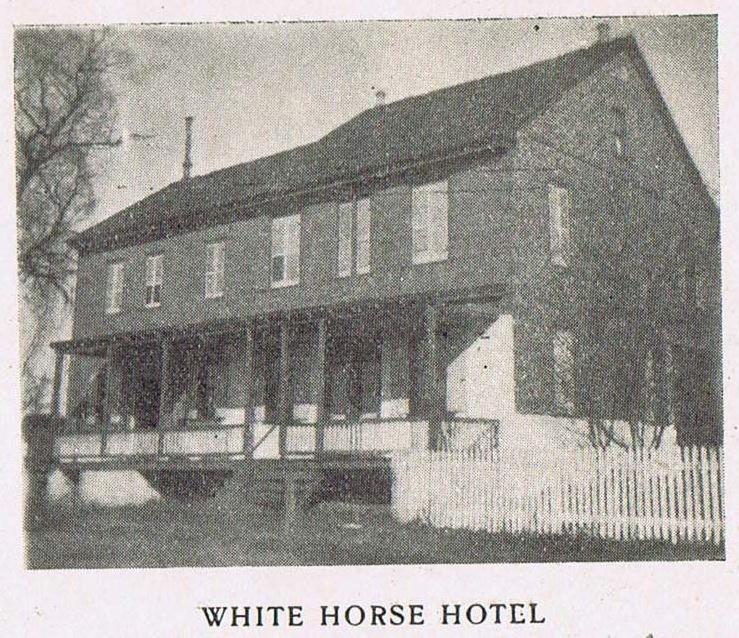
Later, the building was used as a boarding house for railroad workers. In 1791 another sales notice was posted as follows:
“THAT noted Tavern, known by the name of the White-horse on the main road leading from Philadelphia to Reading, 41 miles from the former, and 13 from the latter, with 120 acres of land, part excellent meadow, with two bearing orchards, on which is erected a large commodious stone dwelling house, kitchen and out-houses, good barn and stabling, with sheds for 30 teams. For particulars, enquire of George Douglass, adjoining the premises.”
On May 7, 1795, Duke De Rochefoucault, a fugitive from the French Revolution, wrote,
“Traveling through the United States of N.A. we stopped at the White Horse Tavern, four miles from Pottsgrove. This inn is kept by a Frenchman, a native of Lorraine, who has married an American woman, the daughter of a native of Avignon, by a woman from Franchecomte. The whole family speaks bad English and bad French but probably good German. They pay a rent of $86.00 for 50 acres of land and the house; their owner lives very near & keeps a shop. The house and the land which is of very good quality, would have been worth $60 more had it been let to a private family. But the shopkeeper had very justly calculated that a good tavern so near his house was of more value to him than $60, and that a well frequented inn could not but procure customers to his shop, from whom he would be likely to derive advantages far exceeding the sum which he thus sacrificed. The good people of the inn enquired with much eagerness for news from France, etc. The situation of this borough and likewise of all the other places on the road from Pottsgrove to Reading is delightful.”
By 1915 the building had been converted to apartments. The eastern apartment was used by a Thomas Clark, the middle one by Ed Knauer, and the western one by Henry Knauer who also had a shoemaker’s shop. Another tenant of the eastern apartment at another time was William Bush who had a disabled Civil War veteran living with him. This veteran was confined to a wheelchair at the time. Also, a Pat McGovern occupied the center apartment for a time and was a puddler at the Douglassville Iron Works which were owned by David Knauer.
 Architectural History
The original tavern structure (the 3 bays on the right when facing the façade elevation) is of the Georgian style; its principal façade is constructed of coursed, dressed sandstone with key-stoned lintels. The remaining three perimeter walls are constructed of roughly coursed sandstone but are not squared or dressed. The interior tavern layout is an accurate re-fabrication based on the locations of surviving fireplace support-vaults and bearing cross-walls in the cellar.
The building, then a boarding house or “Hotel”, was purchased by the Historic Preservation Trust of Berks County in 1971. The 1972-85 restoration of the first floor to the original tavern floor plan included construction of the new kitchen-service area behind the Federal addition. In 1972 Hurricane Agnes flooded the entire area and water rose to fourteen feet high on the ashlar facade.
The oak flooring in the north room (the “meeting” room) on the first floor is original. Also, the head and jamb panels surrounding the windows in the second floor’s south room are original.
In the early periods, there would have been a large stable nearby, as wayside taverns customarily provided overnight shelter and feed-grains for horses. The 1791 sale notice included “Stabling sheds for 30 Teams” of horses!
When George Douglass, Jr. died in 1833, his daughter Elizabeth Buckley inherited the property. Elizabeth and her descendants owned the building until 1944. In 1944, Earl Schurr bought the property. The Historic Preservation Trust of Berks County acquired the property in 1971. On April 21, 1975, the structure was listed on the National Register of Historic Places.
Interested in learning more about the White Horse Inn and the Historic Preservation Trust of Berks County? Search records, pictures, images, architectural drawings and more in our Online Archive .